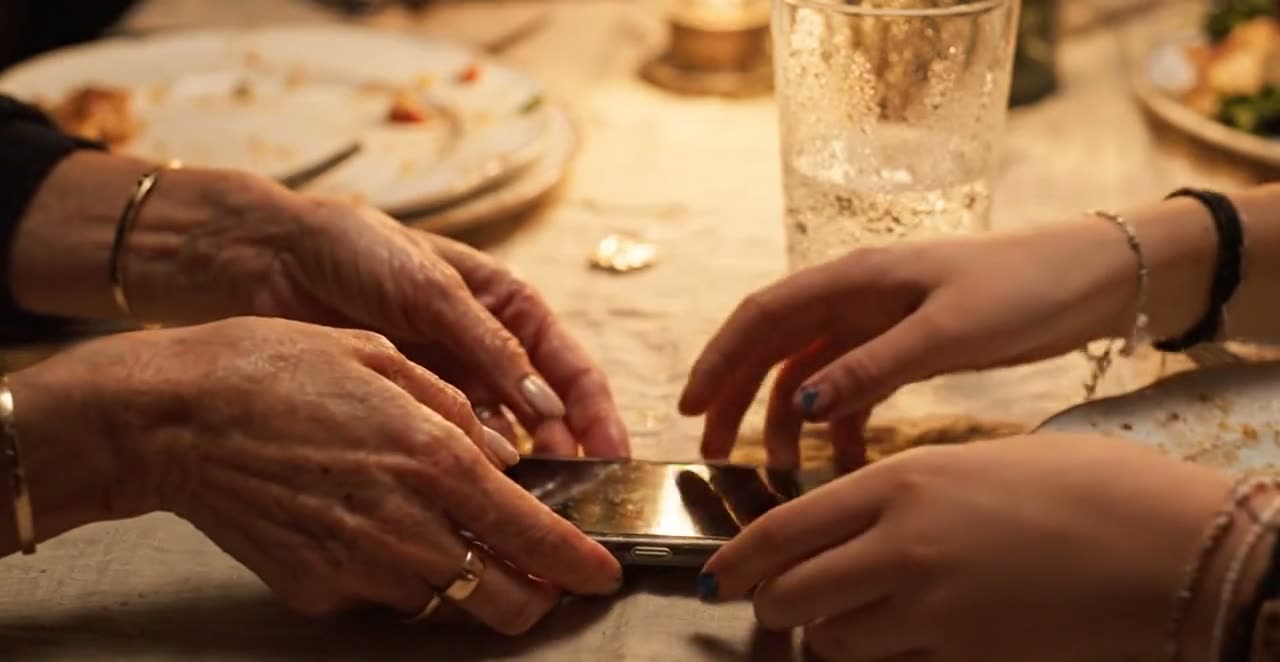
Every week your family sits down together, you add a few pages to something. Nobody thinks of it that way at the time. You are just answering the question in front of you, and then the dishes still need doing.
But a year of that is not nothing. It is fifty-odd entries in your own words, written down while the week was still fresh — who was struggling, what somebody was proud of, the thing that was funny in March that you would never have remembered by June. That is not a data set. That is closer to a first draft of who your family was in a particular year, and there is no way to reconstruct it after the fact. You either wrote it down while it was happening or you did not.
Which raises a question we have not answered well enough. Where does it live?
Right now the honest answer is: on our servers, behind your password, reachable through an app on a phone you will replace in three years. We have told you from the beginning that the record is yours and that we are not in the business of mining it. We believe that. But a promise about ownership that only holds as long as the company holds is a weaker promise than it sounds. Software rots. Accounts lapse. Companies get acquired by other companies with different ideas about what your family is for. The real test of yours is whether the record survives us.
So at the end of each year, the year becomes a book.
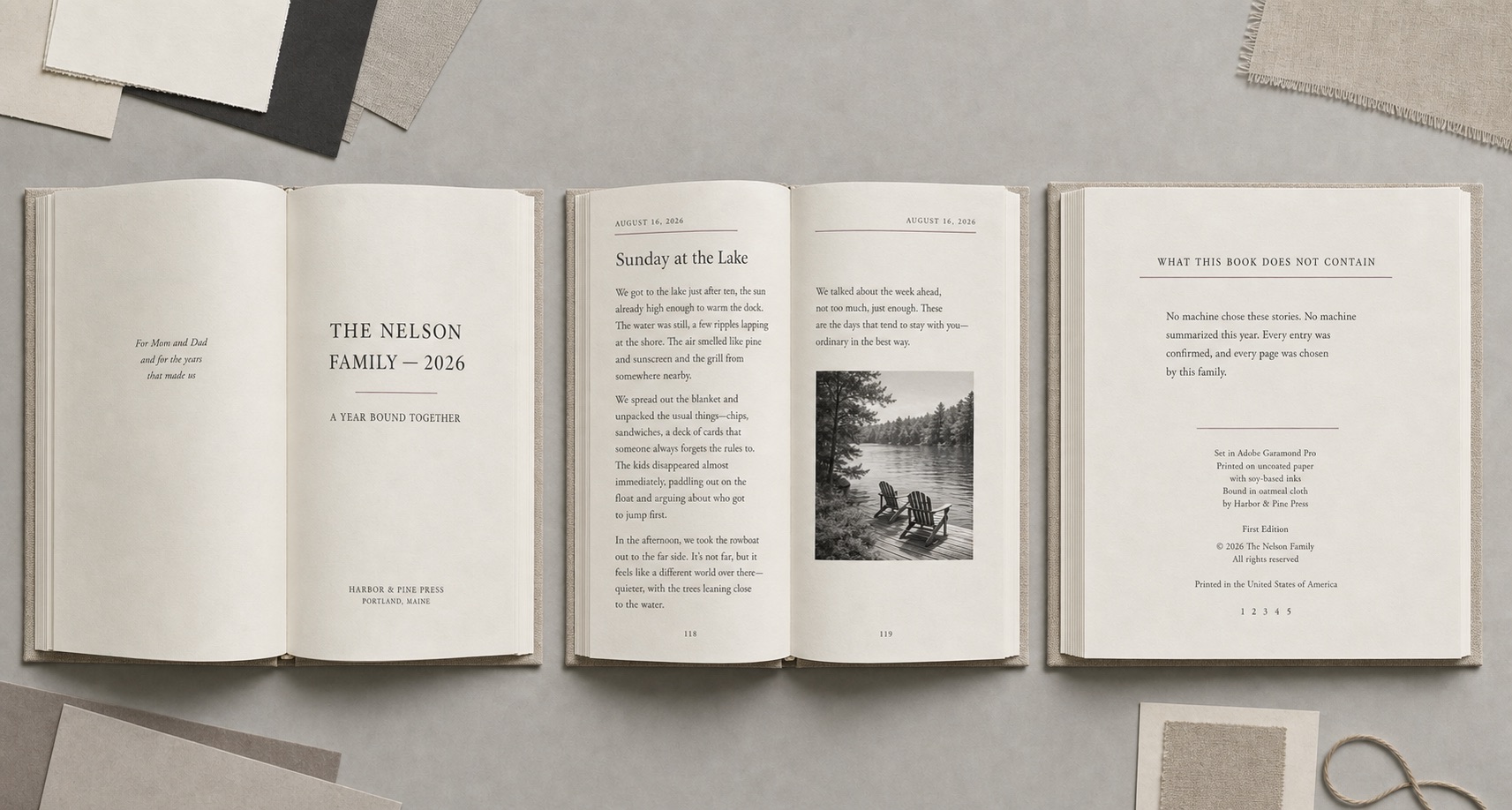
A physical object is a strange thing for a software company to get excited about, and we want to be precise about why we are. It is not nostalgia and it is not a merchandise idea. It is that a printed book is the only version of your record that cannot be revoked, migrated, deprecated, or held hostage by a billing failure. It does not need us. That is the entire point of it.
The page we care most about is the last one. It is a short note about what the book does not contain: no machine chose these stories, no machine summarized this year, every entry was confirmed and every page was chosen by this family. That reads like a modest disclaimer. It is actually the whole editorial position, and it is the hardest constraint we have set for ourselves.
Because here is the thing — we could generate a gorgeous book from your data in about four seconds. Feed a year of entries to a model, ask for themes and a narrative arc and some elegant connective prose, and out comes something genuinely lovely to read. And it would be worthless. Not because the writing would be bad, but because the moment a machine decided which parts of your year mattered, the book stops being a record of your family and becomes a record of what a model inferred about your family. Those are different objects. Only one of them is worth keeping on a shelf for thirty years.
So the curation has to be yours, which means it has to happen during the year rather than at the end of it. You cannot ask a family in December to sift through fifty gatherings. You can ask them, in the moment, when something lands: that one goes in the book. A small mark, made by a person, while the thing is still warm. Add those up over a year and the book has already edited itself, by hand, without anyone having done homework.
Now the part we owe you plainly: this does not exist yet. There is no order page, no price, no date, and the book in the photograph above is a design mockup rather than a proof from a printer. We are not taking money for it and we are not going to pretend it is closer than it is.
We are showing it to you now for one reason. The first edition is being written this year, by families who are sitting down on ordinary evenings and answering the question in front of them. If you are one of them, you should know where all of that is headed — and that the destination is an object you can hand to someone, not a screen you have to log into.
— Clay